
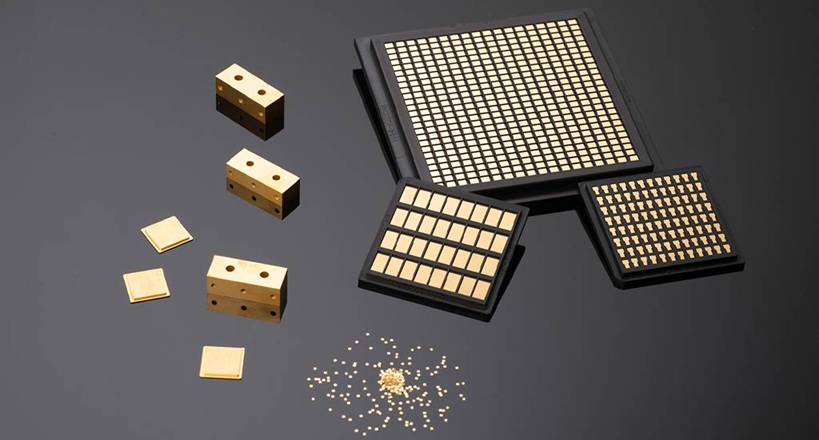
The tungsten heat sink emerged as a solution to a problem that intensified with each generation of electronic devices: how to dissipate heat from increasingly powerful components confined within ever-smaller spaces. As semiconductors grew more capable, their thermal output escalated proportionally, yet the spaces available for cooling systems contracted. Engineers required materials that combined exceptional thermal conductivity with high density, materials that could absorb and transfer heat rapidly whilst occupying minimal volume. Tungsten, a metal whose properties had long fascinated metallurgists, proved ideally suited to this demanding application.
The Material’s Inherent Advantages
Tungsten possesses characteristics that distinguish it from common heat sink materials:
- Melting point of 3,422 degrees Celsius, the highest of any pure metal
- Density of 19.3 grammes per cubic centimetre, nearly twice that of lead
- Thermal conductivity of 173 watts per metre-kelvin
- Exceptional structural integrity under extreme thermal stress
- Ability to provide substantial thermal mass in compact volumes
Whilst tungsten’s thermal conductivity falls below that of copper or aluminium, this characteristic becomes irrelevant in applications where density and temperature resistance outweigh pure conductivity. A tungsten heat sink can occupy a fraction of the space required by aluminium whilst providing comparable thermal performance, a trade-off that proves decisive in applications where every cubic millimetre matters.
Application Domains and Technical Requirements
The deployment of tungsten heat sink technology concentrates in sectors where conventional materials prove inadequate:
- High-power aerospace and military electronics generating extreme heat fluxes
- Satellite systems where weight and volume command premium consideration
- Medical imaging equipment including X-ray tubes and radiation therapy systems
- Industrial laser systems requiring robust thermal management
- Semiconductor manufacturing equipment with intense localised heating
- High-frequency radar installations demanding temperature stability
Singapore’s tungsten heat sink manufacturers have developed particular expertise in serving these specialised markets, where technical requirements eliminate less capable alternatives. Medical applications prove particularly demanding, as failures could compromise patient safety.
Manufacturing Considerations and Methods
Producing tungsten heat sink components requires specialised knowledge and equipment. The metal’s extreme hardness, whilst advantageous in service, complicates machining. Conventional cutting tools wear rapidly, making traditional subtractive manufacturing economically prohibitive for complex geometries.
Powder metallurgy techniques, including metal injection moulding, offer viable pathways:
- Near-net-shape forming reduces material waste and machining requirements
- Complex geometries including fins, channels, and mounting features produced directly
- Material properties match or exceed those of wrought tungsten
- Production costs decrease with volume for series production
- Adequate surface finishes achieved without extensive post-processing
Electrical discharge machining provides another route, particularly for prototypes and low-volume applications. The process removes material through electrical erosion rather than mechanical cutting, bypassing tungsten’s hardness entirely.
Thermal Performance and Design Optimisation
The effectiveness of any tungsten heat sink depends upon proper thermal design. Surface area, critical for heat dissipation, must be maximised within available volume. Engineers employ fins to increase surface area, whilst their spacing and orientation affect airflow patterns. Embedded heat pipes can transport thermal energy from hot spots to areas with greater cooling capacity.
Interface thermal resistance demands careful attention. Surface flatness must be maintained within tight tolerances, whilst thermal interface materials fill microscopic gaps. Singapore’s tungsten heat sink sector has accumulated substantial expertise in optimising these interfaces, recognising that the finest heat sink provides little benefit if thermal energy cannot enter it efficiently.
Computational fluid dynamics and finite element analysis now guide tungsten heat sink design before physical prototypes are constructed. These tools predict temperature distributions, identify hot spots, and evaluate design variations, though they depend upon accurate material property data derived from experience.
Comparative Economics and Material Selection
The decision to specify a tungsten heat sink involves weighing multiple factors:
- Initial material costs exceed aluminium or copper substantially
- Manufacturing expenses run higher due to processing challenges
- Space constraints often justify the premium in confined applications
- Operating temperature extremes eliminate conventional alternatives
- Life cycle durability reduces replacement frequency
- Aerospace applications benefit from weight savings despite higher unit costs
- Military systems prioritise reliability over initial expenditure
In aerospace applications, where launching each kilogramme into orbit costs thousands of pounds, tungsten’s density advantage translates to substantial savings. Military systems, where reliability under punishing conditions outweighs cost considerations, routinely specify tungsten heat sink components.
The Path Forward
Thermal management challenges will only intensify as electronic devices continue toward higher power densities and smaller form factors. Silicon carbide and gallium nitride semiconductors, though more efficient than silicon predecessors, still generate heat requiring management. Quantum computing systems need precise thermal control. Electric vehicle power electronics pack kilowatts into increasingly compact spaces.
These evolving requirements ensure continued relevance for advanced thermal management solutions. The tungsten heat sink, with properties that cannot be replicated by combining common materials, occupies a secure position serving applications where performance requirements exclude compromise. Manufacturers who master tungsten processing complexities, who understand the interplay of thermal physics and material properties, position themselves to serve industries that increasingly depend upon the exceptional capabilities that only a tungsten heat sink can provide.